
Best Luxury Safari Lodges in Tanzania
- September 23, 2026
- Accomodations, For Travelers, Safari Planning
Best Luxury Safari Lodges in Tanzania: Where to Stay for an Exceptional Safari Choosing where to stay can completely change the way... Read More
 by Safari Lala
A 5-day Serengeti and Ngorongoro Crater safari is one of the best ways to experience northern Tanzania in a relatively short time. The itinerary combines two of the country’s most famous wildlife destinations, with enough time for several game drives without making the journey feel rushed.
You will spend around 2 nights in the Serengeti and 1 night around Ngorongoro, with the remaining time used for travelling between the parks and Arusha. The route works particularly well for first-time safari travellers who want to see the Big Five, explore the Serengeti plains and descend into the Ngorongoro Crater.
A 5-day safari can also be combined with Zanzibar. After returning to Arusha, you can take a short domestic flight to the coast and spend several more days relaxing on the beach.
The safari normally starts and ends in Arusha. The total driving distance depends on the exact route and accommodation, but the journey covers a large part of northern Tanzania.
Day 1: Arusha to Serengeti National Park
Day 2: Full-day Serengeti safari
Day 3: Serengeti to Ngorongoro
Day 4: Ngorongoro Crater game drive
Day 5: Ngorongoro to Arusha
For a more relaxed experience, the itinerary can also be arranged with 3 nights in the Serengeti and a shorter stay around Ngorongoro, depending on your priorities.
Your safari begins in Arusha, usually between 7:00 AM and 8:00 AM. After meeting your safari guide, you leave the city and travel towards Serengeti National Park.
The drive to the Serengeti is long, but it is part of the adventure. The journey can take approximately 7–9 hours by road, depending on your route, stops and road conditions. You pass through changing landscapes before reaching the open plains of the Serengeti.
Many travellers also choose to fly to the Serengeti. A scheduled or charter flight can reduce the journey considerably and is useful if you want to spend more time on safari.
Once you enter the park, your safari begins. Depending on your arrival time, you may enjoy an afternoon game drive before heading to your camp or lodge.
The first evening is a chance to settle into the Serengeti. Dinner is usually followed by a quiet evening at your accommodation, surrounded by the sounds of the African bush.
Day 2 is dedicated entirely to the Serengeti.
You usually leave your accommodation early, often around 6:00 AM, when temperatures are cooler and many animals are active. Your guide will choose the best route based on recent wildlife sightings and the season.
The Serengeti covers approximately 14,750 square kilometres, so you cannot explore the entire park in one day. Instead, your guide focuses on areas with the best opportunities for wildlife viewing.
Lions are one of the major attractions. You may find them resting after an early hunt or moving through the grasslands in search of prey. Elephants, giraffes, buffalo, zebras and wildebeest are also commonly seen.
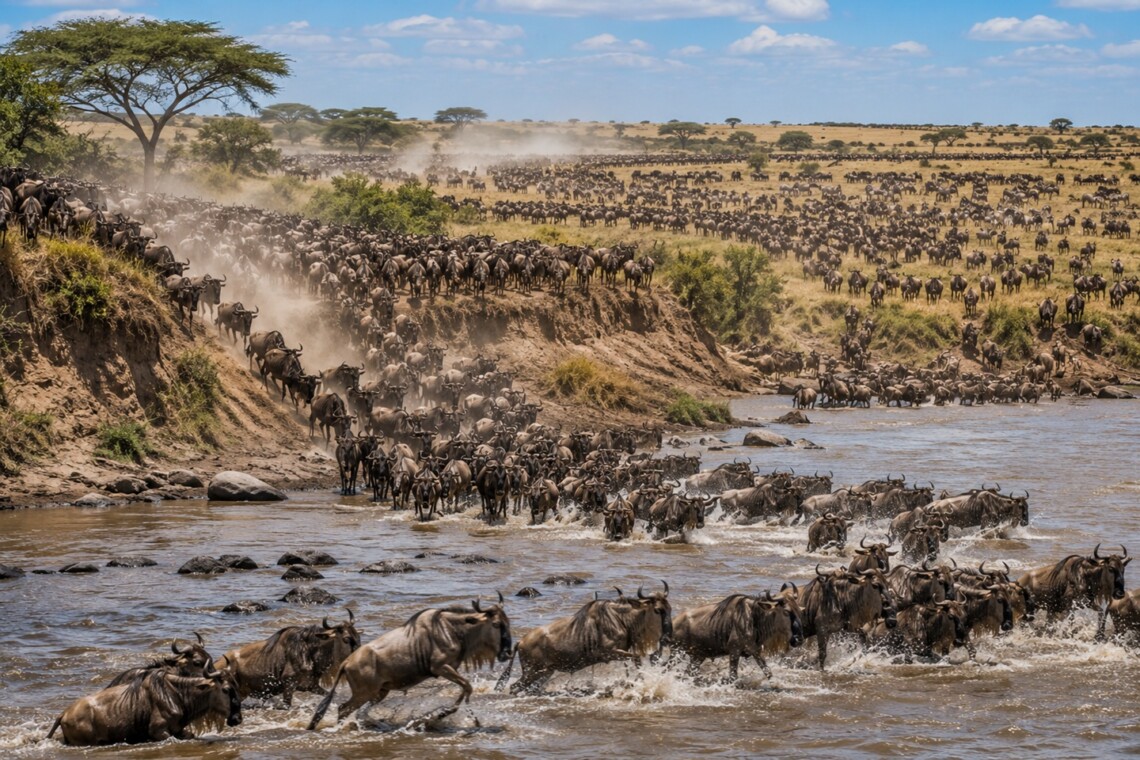
If you travel during the Great Migration, the location of the herds becomes particularly important. The migration moves through different parts of the ecosystem during the year, so your accommodation should be selected according to the season.
You can spend most of the day on game drives before returning to camp in the late afternoon.
After dinner, you can relax around the campfire and enjoy the atmosphere of the Serengeti.
After breakfast, you leave the Serengeti and begin travelling towards the Ngorongoro Conservation Area.
The journey allows you to enjoy another game drive as you leave the park. Depending on the route and timing, you may stop for lunch before continuing towards the Ngorongoro highlands.
The landscape gradually changes as you approach the crater.
The open plains give way to forest and cooler highland scenery. By late afternoon, you can reach your lodge or camp near the crater.
If you are staying on or close to the crater rim, the view can be spectacular. The crater stretches below you, surrounded by steep walls and green forest.
Temperatures can drop significantly at night because of the altitude, so a warm jacket is useful.
After dinner, get some rest because the next morning begins early.
Day 4 is dedicated to one of the highlights of the safari.
You descend into the Ngorongoro Crater early in the morning for a game drive.
The crater is approximately 20 kilometres wide and covers around 260 square kilometres. Its enclosed environment supports a remarkable concentration of wildlife.
You can expect to see animals such as lions, buffalo, zebras, wildebeest and hippos. Elephants can also be seen, particularly in the forested areas.
Ngorongoro is also one of Tanzania’s important habitats for the black rhinoceros. Seeing one is never guaranteed, but the crater provides one of the better opportunities in the country.
The game drive can last several hours. You may stop for a picnic lunch in a designated area before continuing your exploration.
Unlike the Serengeti, where wildlife can be spread across enormous distances, the crater provides a more concentrated safari experience.
By afternoon, you ascend from the crater and return to your accommodation.
This is your final night in the Ngorongoro area.
After breakfast, you begin your journey back to Arusha.
The drive usually takes several hours, depending on your accommodation and stops along the way.
You can arrive in Arusha in the afternoon, giving you enough time to connect with another part of your Tanzania journey.
Many travellers continue from Arusha to Zanzibar. Domestic flights make the connection relatively convenient, particularly if you want to finish your safari with several days on the beach.
Others continue to Kilimanjaro International Airport for their international flight.
Your 5-day Serengeti and Ngorongoro safari ends in Arusha.
The price depends heavily on the type of safari you choose.
As a general planning range, a 5-day budget or shared safari may cost around US$1,000–$1,500 per person. A comfortable mid-range safari can be around US$1,500–$2,500 per person, while a luxury private safari can reach US$3,500–$6,000 or more per person.
These are planning estimates rather than fixed prices. Rates can change depending on the season, accommodation, group size, vehicle, park fees and whether flights are included.
A private safari usually costs more because the vehicle and guide are dedicated to your group.
Travelling with several people can reduce the per-person cost because vehicle expenses are shared.
Luxury accommodation can also make a significant difference. Staying at a high-end Serengeti camp and a premium crater-rim lodge can increase the overall price considerably.
Most safari packages include accommodation, meals, a safari vehicle, a professional guide and game drives.
Park and conservation fees are also normally incorporated into the package price, although this should always be confirmed before booking.
Airport transfers may be included depending on the operator.
International flights are generally not included.
Tips, drinks, travel insurance and personal expenses are also usually separate.
If you are comparing two safari prices, look at the complete package rather than comparing the headline price alone.
A cheaper safari may exclude important costs that are included in a more expensive package.
Yes.
Five days provides enough time to experience both destinations, particularly if the itinerary is planned efficiently.
You have approximately 2 full days focused on the Serengeti when arrival and departure game drives are taken into consideration. You then have a dedicated day for the Ngorongoro Crater.
However, the Serengeti is enormous.
If wildlife is your main priority, adding another 1–2 nights in the Serengeti can make the safari even better.
A longer stay gives your guide more time to explore different areas and increases your opportunities to encounter interesting wildlife behaviour.
The best time depends on what you want to see.
From around June to October, the dry season generally offers excellent wildlife viewing conditions. Animals often gather around water sources, while thinner vegetation can make them easier to spot.
The Great Migration follows a different pattern.
Around January and February, large numbers of wildebeest gather in the southern Serengeti and Ndutu area for the calving season.
From around July to October, the northern Serengeti becomes particularly important as the herds move towards the Mara River area.
The exact timing changes every year, so migration-focused safaris should be planned with some flexibility.
Ngorongoro remains a strong destination throughout the year because many resident animals remain in the crater.
The best location depends on when you travel.
Central Serengeti is popular because it provides a good base for year-round wildlife viewing and has a wide selection of camps and lodges.
Northern Serengeti is particularly attractive during the migration period when the herds move towards the Mara River.
Southern Serengeti and Ndutu are important during the calving season.
For a 5-day safari, choosing the right location is especially important. You do not want to spend several hours driving between your accommodation and the wildlife areas you came to see.
Your accommodation should therefore be selected according to the season.
Staying near the crater can make the itinerary much easier.
Many luxury properties are located on or near the crater rim, offering dramatic views across the caldera.
Other accommodation options are located farther away around Karatu and the surrounding highlands.
If your budget allows, a crater-rim property can be a memorable part of the safari. You can wake up above the crater and begin your game drive relatively early.
For budget-conscious travellers, staying farther away can reduce the accommodation cost while still allowing you to visit the crater.
Yes, it is possible.
The Serengeti and Ngorongoro are both strong destinations for Big Five viewing.
Lions are commonly encountered in both areas.
Buffalo are also widespread, while elephants can be seen in different habitats across the route.
Leopards are more elusive. Your guide may need patience and time to locate one.
Rhinoceros are the most difficult of the Big Five to see. Ngorongoro provides one of the better opportunities, particularly for black rhinoceros, but sightings are never guaranteed.
A safari is ultimately about observing wildlife in its natural environment.
The unpredictability is part of what makes it exciting.
Yes, and it is one of the most popular combinations.
After your safari ends in Arusha, you can fly to Zanzibar and spend another 3–5 nights on the coast.
This creates a complete Tanzania holiday.
The first five days are filled with game drives and wildlife.
The following days are slower.
You can spend time on the beach, explore Stone Town, take a sunset cruise or simply relax at your hotel.
For couples and honeymooners, the combination of Serengeti, Ngorongoro and Zanzibar is particularly popular.
Pack lightweight clothing for the warm days on safari and a warm layer for early mornings.
Ngorongoro can be cold because of its elevation, especially before sunrise and after sunset.
Comfortable shoes are useful, although you will spend most of your safari in a vehicle.
A hat, sunglasses and sunscreen are essential.
Binoculars are also useful for spotting animals at a distance.
If you are bringing a camera, carry extra batteries or a power bank because charging opportunities can be limited in some safari camps.
A 5-day Serengeti and Ngorongoro Crater safari offers an excellent balance between time, wildlife and cost.
You spend around 2 nights in the Serengeti, explore the crater for a full day and return to Arusha on the fifth day.
The route covers two of Tanzania’s most iconic safari destinations without requiring a two-week holiday.
For budget travellers, prices can start at around US$1,000 per person, while mid-range and luxury safaris can cost considerably more depending on accommodation and season.
The most important decision is choosing the right route and accommodation for your travel dates.
If you want to extend the trip, adding 3–5 nights in Zanzibar creates a relaxing beach ending after your safari.
Safari Lala can help you discover accommodation and safari experiences in the Serengeti and Ngorongoro, making it easier to plan your Tanzania safari around your budget, travel dates and preferred style.
Best Luxury Safari Lodges in Tanzania: Where to Stay for an Exceptional Safari Choosing where to stay can completely change the way... Read More

For many travelers, Arusha is the starting point for an unforgettable Tanzania safari. If your main goal is to visit Serengeti National... Read More

Zanzibar is famous for white-sand beaches,... Read More
Mana Pools National Park is one... Read More
Africa is one of the world’s... Read More
Join The Discussion