What Is the Great Migration?
The Great Migration is one of the most remarkable wildlife spectacles on Earth and one of the main reasons travelers from around the world visit Serengeti National Park. Each year, more than two million wildebeest, accompanied by hundreds of thousands of zebras and gazelles, move in a continuous circular journey across the Serengeti ecosystem in Tanzania and north into Kenya’s Maasai Mara. This movement is driven by rainfall, fresh grazing, and the search for water, making it a natural cycle rather than a single one-time event. Unlike many people imagine, the migration never truly stops. The herds are always moving, responding to the rhythm of the seasons. Along the way they face river crossings, predators, long treks across open plains, and changing landscapes. For safari travelers, the Great Migration offers an opportunity to witness raw nature in motion, whether it is thousands of calves being born in the south, dramatic river crossings in the north, or endless columns of animals moving across the plains.
The Wildebeest Migration Overview
At the center of the Great Migration is the wildebeest, also known as the blue wildebeest. Around 1.5 million wildebeest lead this movement through the Serengeti ecosystem every year. Their migration follows a seasonal pattern shaped by rainfall and grass growth. As rains arrive, new nutrient-rich grasses grow, attracting the herds. Once the grazing is exhausted or water becomes scarce, they continue moving in search of better conditions.
The migration usually begins in the southern plains near Ndutu, where calving season takes place between January and March. As the dry season approaches, the herds move west and north through central Serengeti before reaching the northern Serengeti and the Mara River. Later in the year, they gradually return south as the rains begin again. This circular movement repeats year after year and has continued for thousands of years. It is one of the oldest surviving wildlife migrations on the planet and remains one of Africa’s most iconic safari experiences.
Zebra and Gazelle Movement Within the Migration
While wildebeest are the most visible participants, the Great Migration is far more than a wildebeest event. Roughly 300,000 zebras and hundreds of thousands of Thomson’s gazelles travel alongside them. Each species plays a different role in the movement.
Zebras often graze first because they eat the taller, rougher grasses. Wildebeest then follow behind, feeding on the shorter grass left after zebras have passed. Gazelles usually feed on the fresh shoots that emerge afterward. This natural sequence allows different animals to share the same grazing lands without directly competing for the exact same food source.
Their combined movement creates an extraordinary visual experience across the Serengeti plains. Travelers often see long lines of zebras stretching across the horizon with wildebeest packed closely behind, while gazelles move around the edges of the herd. Together they form one of the largest remaining land-animal migrations in the world and help shape the landscape through constant movement and grazing.
Why the Great Migration Happens
The Great Migration happens for one essential reason: survival. Rainfall determines where fresh grass grows, and fresh grass determines where the herds go next. Wildebeest rely heavily on short, nutrient-rich grasses, particularly those rich in minerals that support breeding and calf development. As seasonal rains move across the Serengeti ecosystem, the animals follow.
Water is another major factor. During dry periods, permanent water sources become increasingly important, pushing the herds toward rivers and wetter regions. This constant search for food and water creates the migration cycle seen each year.
Instinct plays a huge role as well. Wildebeest calves are born into this rhythm and begin moving with the herd almost immediately. Generations have followed the same routes through the Serengeti ecosystem, guided by rainfall patterns and survival behavior. The result is a continuous natural movement that never truly ends. There is no official start or finish line, only an endless cycle linked to the seasons.
The Ecological Importance of the Great Migration
The Great Migration is not only visually spectacular, it is also essential to the health of the Serengeti ecosystem. As millions of animals move through the landscape, they graze large areas of grassland, helping maintain the balance between grass growth and vegetation spread. Their hooves turn the soil, their waste fertilizes the land, and their movement helps regenerate the plains.
Predators depend heavily on the migration. Lions, hyenas, leopards, cheetahs, crocodiles, and scavengers all benefit from the abundance of prey moving through the region. Calving season in particular creates a surge in predator activity, while river crossings attract crocodiles waiting along the riverbanks.
Birdlife also benefits. Vultures, eagles, storks, and many other species follow the herds and rely on the migration for food and ecological opportunity.
Without the Great Migration, the Serengeti would not function as it does today. It is one of Africa’s most important natural systems, a living cycle connecting grasslands, predators, herbivores, waterways, and seasonal rainfall. This is why it is often considered one of the greatest wildlife events on Earth and one of the most unforgettable safari experiences in Tanzania.
Where Does the Great Migration Take Place?
The Great Migration takes place across the vast Serengeti-Mara ecosystem, a massive wildlife region stretching from northern Tanzania into southern Kenya. Although many travelers refer to it simply as “the Serengeti migration,” the movement covers several distinct areas, each playing a different role throughout the year. From the southern plains where wildebeest calves are born, to the dramatic Mara River crossings in the north, the migration follows rainfall and fresh grazing in a continuous circular route. Understanding where the migration happens is one of the most important parts of planning a safari, because the best place to see it depends entirely on the season.
Below is a guide to the main regions where the Great Migration unfolds.
Serengeti National Park: The Heart of the Migration
Serengeti National Park is the beating heart of the Great Migration and the place most travelers associate with this incredible wildlife event. Located in northern Tanzania, Serengeti National Park covers nearly 15,000 square kilometers of plains, woodland, and river systems. It is here that the majority of the migration spends most of the year.
The Serengeti is not just one landscape. It includes southern short-grass plains, central savannah, western corridors, and northern river systems. Because of this diversity, the migration moves through different parts of the park depending on rainfall patterns and grass availability.
For safari travelers, the Serengeti offers year-round migration viewing opportunities. At different times of year you may witness calving season in the south, giant moving columns in central Serengeti, or dramatic river crossings in the north. This is what makes the park one of Africa’s most iconic safari destinations. Even outside peak migration months, the Serengeti remains exceptional for wildlife viewing thanks to resident lions, elephants, leopards, cheetahs, giraffes, and countless bird species.
Ngorongoro Conservation Area: Gateway to the Southern Plains
Ngorongoro Conservation Area forms an important part of the wider migration ecosystem. While many visitors know Ngorongoro for the famous crater, the broader conservation area extends into the southern plains bordering Serengeti.
These open grasslands provide seasonal grazing that becomes especially important during the green season. Nutrient-rich volcanic soils make the grasses highly valuable for wildebeest, especially females preparing to give birth.
Ngorongoro is often combined with Serengeti itineraries because it offers easy access to the migration’s southern route while also providing completely different scenery, from highland forests and crater views to sweeping open plains. Many safaris begin through the Ngorongoro region before continuing into Serengeti, making it both a gateway and an important ecological extension of the migration.
Ndutu: The Calving Season Destination
Ndutu is one of the most important locations in the migration calendar and one of the best places to visit between December and March. Located between southeastern Serengeti and the Ngorongoro Conservation Area, Ndutu becomes the center of the Great Migration during calving season.
This is where hundreds of thousands of wildebeest gather on the open plains to give birth. Over a short period, thousands of calves can be born every day. The landscape becomes filled with newborn wildebeest taking their first steps within minutes of birth.
Ndutu is also one of the best safari regions for predator action. Lions, cheetahs, hyenas, jackals, and leopards are highly active during this period because of the abundance of vulnerable young animals. For photographers, wildlife filmmakers, and travelers hoping to witness dramatic predator-prey interaction, Ndutu is one of the most rewarding safari locations in Tanzania.
Northern Serengeti: Home of the River Crossings
Northern Serengeti is famous for one of the most dramatic moments in the Great Migration: the river crossing season.
Between roughly July and October, large herds move north toward the Kenya border. As they gather along the Mara River, thousands of wildebeest often wait on the riverbanks before suddenly crossing in massive waves. These crossings are unpredictable, intense, and unforgettable to witness.
Northern Serengeti is more remote than central areas of the park, which adds to its exclusivity. The scenery includes rolling hills, river forests, and open plains, creating a different feel from southern Serengeti. This region is especially popular with travelers specifically hoping to see dramatic migration action during peak dry season.
Mara River: The Most Dramatic Crossing Point
Mara River is perhaps the most iconic location of the Great Migration. Stretching across northern Serengeti into Kenya, the river becomes a major obstacle in the path of migrating herds.
Crossing it is dangerous. Wildebeest face steep riverbanks, fast-moving water, panic within the herd, and predators waiting in the river—especially Nile crocodiles. Yet they continue crossing because the greener grazing on the other side draws them forward.
What makes the Mara River so famous is the unpredictability. Herds may gather for hours or even days before one animal suddenly jumps and thousands follow. Every crossing is different. Some happen quickly. Others create dramatic scenes of hesitation, chaos, and survival.
For many safari travelers, witnessing a Mara River crossing is a once-in-a-lifetime experience and one of the most sought-after wildlife moments in Africa.
The Maasai Mara Connection in Kenya
Maasai Mara National Reserve is the northern extension of the migration route and directly connected to Serengeti through the wider ecosystem. There are no fences between the two regions, allowing wildlife to move freely across the Tanzania-Kenya border.
After crossing the Mara River, many herds spread into the Maasai Mara where fresh grazing awaits. They typically remain there during part of the dry season before beginning the gradual journey south again as rains return to Tanzania.
This cross-border movement is what makes the Great Migration unique. It is not limited by national boundaries, it is one connected ecosystem shared between Tanzania and Kenya.
For travelers planning a safari, this means the migration can be viewed from either side depending on timing. However, Tanzania’s Serengeti holds the migration for a larger portion of the year, especially in the southern and central stages. Kenya’s Maasai Mara becomes particularly important during the northern dry-season phase when the herds move across the border.
Together, the Serengeti and Maasai Mara create one of the last great wildlife migration systems left on Earth, a living landscape shaped by rainfall, movement, and survival across East Africa.
Great Migration Month-by-Month Calendar
One of the most common safari questions travelers ask is: “Where is the Great Migration right now?” The answer depends entirely on the month, seasonal rainfall, and grazing conditions. The migration follows a circular pattern through the Serengeti ecosystem, but nature doesn’t run on a fixed schedule. Rain can arrive early or late, which slightly shifts the movement each year.
That said, there is a reliable seasonal pattern. Understanding where the herds are month by month helps travelers choose the best safari destination, best accommodation, and best travel dates depending on what they hope to see—whether it’s calving season, long columns of wildebeest on the move, or dramatic river crossings.
Below is a month-by-month guide to the Great Migration in Tanzania.
January – Southern Serengeti and Ndutu Plains
January is one of the most beautiful times to see the Great Migration in Tanzania. During this period, the herds gather across the southern Serengeti plains and around Ndutu. Seasonal rains bring fresh green grass, and thousands of wildebeest spread across the short-grass plains feeding heavily before calving season begins.
The landscape is lush, green, and open, making it excellent for photography. Massive herds can often be seen stretching across the horizon alongside zebras and gazelles. Predators remain active because large prey concentrations attract lions, hyenas, cheetahs, and jackals.
January is ideal for travelers looking for:
- green season landscapes
- huge grazing herds
- fewer crowds compared with river crossing season
- predator sightings on open plains
This is the beginning of one of the most important phases of the migration.
February – Calving Season Begins
February is famous for wildebeest calving season and is one of the most extraordinary safari experiences in Africa. The southern plains around Ndutu become a nursery for the migration. Over a few weeks, hundreds of thousands of wildebeest calves are born.
Many births happen within a very short window. Newborn calves are able to stand and move shortly after birth, which is essential for survival in predator territory.
This is also one of the best predator-viewing months in the Serengeti ecosystem. Lions, cheetahs, hyenas, leopards, and scavengers are highly active around calving grounds because prey is abundant.
Travelers visiting in February often come specifically for:
- wildebeest calving season
- dramatic predator action
- photography safaris
- green landscapes
For many safari lovers, February offers one of the richest wildlife experiences of the year.
March – Calving Continues and Herds Build
March continues the southern Serengeti migration season. Many wildebeest remain in Ndutu and southern Serengeti while late calving continues. Herd sizes remain enormous and predator activity stays intense.
The grasslands are still rich from the rains, and the ecosystem feels full of life. Young calves are now visible across the plains moving closely with the adults. Lions and cheetahs often patrol these areas regularly.
March is excellent for travelers wanting:
- baby wildebeest sightings
- predator-prey interaction
- fewer safari vehicles than peak dry season
- dramatic landscapes
Toward the end of March, the first signs of movement may begin as herds gradually prepare to leave the southern plains.
April – Migration Begins Moving Northwest
By April, many herds start moving away from the southern plains. This marks the beginning of a major shift in the migration route.
The movement usually turns toward central Serengeti and western corridors as the animals follow changing rain patterns and search for new grazing.
April often coincides with the long rains in Tanzania. Roads can become muddy and some camps close seasonally, but wildlife remains excellent.
This month offers:
- dramatic migration movement
- fewer tourists
- green scenery
- excellent value for safari pricing
For travelers who enjoy quieter safari experiences and don’t mind occasional rain, April can be highly rewarding.
May – Long Columns Across the Central Serengeti
May is one of the most spectacular migration movement months.
Huge columns of wildebeest often begin crossing through central Serengeti in large numbers. This is when travelers may witness what many imagine when thinking of the Great Migration: endless lines of animals moving across open savannah.
Central Serengeti becomes a key migration zone. Herds may also move through the western corridor.
May often offers:
- huge herd density
- dramatic movement scenes
- fewer visitors than July–September
- excellent predator sightings
It is also one of the best months for photographers wanting wide landscape shots with large herd movement.
June – Movement Toward the Western Corridor and North
By June the migration continues pushing northwest. Many herds move through the western Serengeti corridor and begin heading toward northern Serengeti.
This period often includes river crossings in the Grumeti region, though these are different from Mara River crossings and generally less predictable for visitors.
Western Corridor becomes important during this stage.
June is often considered a transition month because:
- movement is active
- dry season begins
- wildlife viewing improves with thinner vegetation
- herds spread through large areas
It is a strong safari month before peak northern migration season begins.
July – Arrival in Northern Serengeti
July marks the beginning of one of the most famous migration seasons: northern Serengeti river crossing time.
Many herds begin arriving in Northern Serengeti near the Mara River.
Travelers visiting during July often hope to see:
- wildebeest gathering near riverbanks
- early river crossings
- dry season safari conditions
- excellent predator sightings
Crossings are unpredictable and depend on herd behavior, water levels, and grazing patterns. Sometimes herds wait for hours or days before crossing.
Northern Serengeti becomes one of Tanzania’s most sought-after safari destinations during this time.
August – Peak Mara River Crossing Season
August is often considered one of the most dramatic months of the Great Migration.
Thousands of wildebeest gather around Mara River and crossings can happen with little warning.
This is the classic migration scene many travelers dream of:
- giant dust clouds
- wildebeest packed tightly on riverbanks
- crocodiles waiting below
- massive crossings into or out of the river
Northern Serengeti is extremely popular during August, particularly for photographers and first-time safari travelers wanting to witness the migration’s most dramatic moments.
Accommodation should often be booked far in advance.
September – Continued River Crossings in the North
September remains an excellent month for northern Serengeti migration safaris.
Large herds continue moving around the Mara River region, and crossings can still happen frequently depending on conditions.
Dry season landscapes make wildlife easier to spot, and predator activity remains high around the river systems.
September is often ideal for:
- river crossing safaris
- photography
- luxury migration camp stays
- dry season game viewing
Many travelers consider September one of the strongest months because it combines excellent migration viewing with stable weather.
October – Northern Serengeti and Return Movement Begins
In October many herds remain in northern Serengeti or move between Tanzania and Kenya depending on rainfall.
Some animals begin shifting southward while others continue grazing in the north.
Crossings may still occur, though timing becomes less predictable.
October offers:
- continued migration opportunities
- lower visitor numbers than August peak
- excellent dry-season safari conditions
- predator sightings around river systems
It can be a fantastic month for travelers wanting migration viewing without peak-season crowd levels.
November – The Journey South Begins
November often marks the beginning of the southern return migration.
As short rains begin in Tanzania, the herds gradually start moving back south through eastern and central Serengeti.
The pace depends heavily on rainfall patterns. If rains arrive early, movement can be faster.
November safaris may offer:
- moving herds across central Serengeti
- green season beginning
- lower safari traffic
- excellent wildlife viewing
This is a transitional month where the migration route starts resetting toward the southern plains.
December – Return to Southern Serengeti
By December many wildebeest have returned toward the southern Serengeti and Ndutu region, completing the annual migration cycle.
Fresh rains bring new grazing, and the southern plains begin filling again with wildebeest, zebra, and gazelle.
The landscape becomes greener and more dramatic as the wet season returns.
December is excellent for:
- green season safaris
- large herd viewing
- photography
- preparing for the upcoming calving season
This completes the migration circle before January and February begin the cycle once again.
The Migration Never Truly Stops
One of the most important things to understand is that the Great Migration is not a single event—it is a year-round movement.
There is no exact “start date” or “finish date.”
The wildebeest are always moving through the Serengeti ecosystem following:
- rainfall
- fresh grass
- water availability
- instinctive migration routes
Because of this, every month offers something different.
Some travelers choose:
- February for calving season
- May for huge moving columns
- August for river crossings
- December for returning southern herds
No matter when you visit Serengeti National Park, there is always a chance to experience part of one of the greatest wildlife journeys on Earth.
Wildebeest Calving Season
Wildebeest calving season is one of the most extraordinary stages of the Great Migration and one of the most rewarding safari experiences in Tanzania. Every year, hundreds of thousands of wildebeest gather across the southern Serengeti ecosystem to give birth in a short and intense seasonal window. For wildlife lovers, photographers, and first-time safari travelers alike, this period offers a rare chance to witness new life unfold on the African plains at an incredible scale.
Unlike the dramatic river crossings of the northern Serengeti, calving season is about beginnings. It is a time when the open grasslands fill with newborn wildebeest calves, protective mothers, patient predators, and endless movement across fresh green plains. The landscape feels alive in every direction. Herds stretch beyond the horizon, newborn calves take their first steps within minutes of birth, and predators move through the ecosystem knowing this is one of the most active feeding periods of the year.
For many safari experts, wildebeest calving season is one of the best times to visit Tanzania because it combines massive migration herds, excellent predator sightings, beautiful green-season scenery, and dramatic wildlife behavior all in one place.
When Wildebeest Calves Are Born
Calving season usually takes place between late January and March, with February often considered the peak month. During this period, the Great Migration settles across the short-grass plains of southern Serengeti National Park and the Ndutu region, where grazing conditions are ideal for mothers preparing to give birth.
The timing is closely linked to seasonal rainfall. Short rains that arrive in November and December trigger fresh grass growth across the southern plains. These grasses are rich in nutrients and minerals, creating the perfect feeding conditions for pregnant wildebeest. By the time January and February arrive, the herds have spread across the plains and the calving season begins.
Over the course of just a few weeks, an astonishing number of calves are born. Wildlife researchers estimate that around 500,000 wildebeest calves may be born within this short seasonal period. On some days, thousands of calves arrive within twenty-four hours. Few wildlife events in the world compare to this concentration of births.
One of the most remarkable things about wildebeest calves is how quickly they adapt to life on the move. A calf can often stand within minutes after birth and begin walking shortly afterward. This speed is essential because survival depends on keeping up with the herd. Remaining behind on the open plains would leave a calf extremely vulnerable.
For safari travelers, seeing newborn calves wobbling beside their mothers across the plains is one of the most memorable and emotional wildlife moments Tanzania offers. The sheer scale of life during calving season feels impossible to fully capture until you see it with your own eyes.
Predator Activity During Calving Season
Where there are thousands of newborn wildebeest, predators are never far away. Calving season is not only a season of birth—it is also a season of survival.
The abundance of vulnerable calves attracts intense predator activity throughout the southern Serengeti ecosystem. Lions, cheetahs, hyenas, jackals, leopards, vultures, and scavengers all respond to this period of opportunity.
Lions are especially active across the calving plains. Large prides often position themselves close to the herds, moving with them through the grasslands. Lionesses with cubs benefit from the seasonal abundance of prey, and sightings during this period can be exceptional.
Cheetahs are also commonly seen in the Ndutu region during calving season. The open plains provide ideal hunting conditions for speed-based predators, and young wildebeest calves become frequent targets. Many visitors hoping to see cheetah hunts specifically choose this season for that reason.
Hyenas are another major presence. Often misunderstood, hyenas are highly intelligent and extremely effective hunters. During calving season they are constantly active around the migration herds, particularly during early morning and late afternoon.
This predator-prey balance is what makes calving season so compelling. It is dramatic, raw, emotional, and deeply natural. Birth and death happen side by side on the plains. A newborn calf may take its first steps while predators wait nearby. Yet this pressure is part of the ecosystem’s natural rhythm and one of the reasons the migration remains so powerful to witness.
For photographers and wildlife enthusiasts, predator activity during calving season can be extraordinary because encounters happen frequently across open landscapes with excellent visibility.
Ndutu Plains: The Center of Calving Season
Ndutu is widely considered the heart of wildebeest calving season. Located between southern Serengeti and the Ngorongoro Conservation Area, Ndutu becomes one of Tanzania’s most exciting safari destinations from January through March.
What makes Ndutu special is its unique landscape. The area combines open short-grass plains, seasonal lakes, acacia woodland, and wide natural visibility. These nutrient-rich volcanic grasslands attract huge concentrations of wildebeest because they provide ideal grazing during the calving period.
The plains around Lake Ndutu and Lake Masek often become filled with enormous herds spread across nearly every visible horizon. Wildebeest gather alongside zebra, Thomson’s gazelles, and many resident wildlife species.
Ndutu also allows a different safari experience compared with some parts of the Serengeti because game viewing often feels immersive and active in all directions. Travelers may witness herds grazing, calves nursing, predators stalking, and birds circling overhead all within a short distance.
Another reason Ndutu is highly valued is accessibility to wildlife. During calving season, animals are concentrated and movement happens across open terrain, making sightings frequent throughout the day. The photographic opportunities are exceptional because green landscapes contrast beautifully with wildlife movement and dramatic skies.
For many safari travelers, Ndutu delivers a complete Great Migration experience without needing to travel north for river crossings. Instead of dramatic water crossings, the focus here is on life, birth, predator interaction, and the beginning of the migration cycle.
Why Calving Season Is One of the Best Safari Experiences in Tanzania
While many travelers focus on the Mara River crossings, wildebeest calving season offers a very different but equally spectacular experience. It is quieter in atmosphere yet incredibly active in wildlife behavior.
The southern plains feel expansive and wild, with enormous herds scattered across rich green landscapes. The number of newborn calves is astonishing. Predator encounters can happen at any time. The photography is outstanding, especially with dramatic wet-season skies and open visibility.
Calving season also offers a deeper understanding of the migration itself. It is where the yearly cycle begins again. The next generation of wildebeest enters the world here before eventually moving north with the herds through the Serengeti ecosystem.
For safari travelers interested in wildlife behavior rather than only dramatic crossings, this period is often considered one of the best times to visit Tanzania. It offers emotion, movement, action, beauty, and one of the most important ecological moments in East Africa.
Seeing thousands of wildebeest calves spread across the Ndutu plains is more than just a safari sighting. It is witnessing the renewal of one of the greatest wildlife migrations on Earth—an annual cycle of birth and survival that has shaped the Serengeti landscape for thousands of years.
Mara River Crossing Season
Mara River crossing season is one of the most dramatic wildlife events in Africa and one of the most iconic moments of the Great Migration. For many travelers planning a safari to Tanzania, seeing thousands of wildebeest leap into the river is the ultimate bucket-list experience. It is raw, unpredictable, emotional, and unforgettable. Dust rises from the riverbanks, wildebeest crowd tightly along the edge, zebras pace beside them, and for long moments nothing happens—until suddenly one animal jumps, and the rest follow in a powerful wave of movement.
This is the moment many people picture when they think of the Great Migration. It is also one of the most searched safari experiences in Tanzania, and for good reason. Watching a river crossing in person feels less like a wildlife sighting and more like witnessing one of nature’s greatest survival stories unfold in real time.
July to October: When Mara River Crossing Season Happens
Mara River crossing season typically takes place between July and October, though timing can shift slightly depending on rainfall and grazing patterns. Nature does not follow a strict calendar, so every year is a little different. Some crossings begin earlier, while others continue later into the season.
During these months, the Great Migration moves north through Northern Serengeti toward the Kenya border. Hundreds of thousands of wildebeest gather in the northern Serengeti around the Mara River system, moving back and forth between grazing areas on both sides of the river.
The dry season plays an important role here. As grass becomes scarcer in central and western Serengeti, the herds continue north in search of fresh grazing and water. This movement eventually brings them to the Mara River, which becomes one of the most challenging obstacles of the migration.
July often marks the beginning of activity near the river. By August and September, crossing season is usually at its most intense. October can still offer excellent opportunities, especially when herds remain in the northern Serengeti before beginning the gradual return south.
For safari travelers, these months are considered peak migration season and are among the most popular travel periods in Tanzania.
Wildebeest Crossing Behavior at the Mara River
What makes Mara River crossings so fascinating is how unpredictable they are. There is no schedule, no guaranteed time, and no way to know exactly when the wildebeest will jump.
Large herds often gather at the riverbank and wait. Hundreds—or sometimes thousands—of animals may crowd near the edge for hours. They move forward, then back away. They bunch together tightly, circle, hesitate, and build tension. The river may appear calm, but the energy among the herd feels intense.
Then suddenly, one wildebeest commits and leaps into the water.
Within seconds, dozens or even thousands follow behind.
This moment transforms stillness into chaos. Animals pour down steep riverbanks, splash through fast-moving water, climb muddy slopes on the opposite side, and push forward through sheer instinct and momentum.
Sometimes crossings last only a few minutes. Other times they continue in waves as different groups follow.
The behavior is driven by instinct, pressure from the herd, movement toward grazing, and the need to continue the migration route. Wildebeest often cross multiple times during the season, sometimes moving into Kenya and then back into Tanzania depending on conditions.
This unpredictability is exactly why witnessing a crossing feels so special. No two are ever the same.
Crocodiles and the Danger of the River
The Mara River is not just a crossing point—it is one of the most dangerous places along the migration route.
The river is home to large Nile crocodiles, some of which spend much of the year waiting near crossing points. During migration season, these crocodiles become part of the dramatic predator-prey story unfolding along the riverbanks.
When thousands of wildebeest enter the water, crocodiles use the confusion and current to ambush prey. Their presence adds tension to every crossing and contributes to the sense of danger that surrounds the Mara River.
But crocodiles are only one challenge.
Wildebeest also face:
strong currents,
deep channels,
slippery rocks,
steep muddy banks,
panic within the herd,
and exhaustion after crossing.
Some animals struggle to climb out of the river once they reach the far bank. Others turn back midway. Some crossings are smooth and fast. Others are chaotic and difficult.
Despite these dangers, the herds continue crossing because survival depends on movement. Fresh grazing lies beyond the river, and instinct keeps pushing them forward.
For safari travelers, this combination of danger, instinct, and mass movement is what makes the Mara River crossing one of the most dramatic wildlife spectacles anywhere in the world.
Photography Timing for Mara River Crossings
For wildlife photographers, Mara River crossing season offers some of the most powerful photographic opportunities in East Africa.
Photographing a crossing requires patience because timing is never guaranteed. A herd may arrive at the river and stand there for hours without entering. Then suddenly everything happens at once.
The best photography often comes from waiting, observing herd behavior, and staying ready.
Early morning light is excellent for soft golden tones across the riverbanks and cooler shadows over the water. Late afternoon also creates beautiful warm light, dust glow, and dramatic contrast. During both periods, wildlife movement around the river can be especially active.
Midday crossings can happen too, and while the light is stronger, they can still produce incredible action shots because the drama of the event matters more than perfect lighting.
Some of the most photographed moments include wildebeest gathering tightly at the river edge, animals leaping from steep banks, splashes in the river, crocodile movement in the water, and herds climbing the opposite side in large dusty waves.
Northern Serengeti’s open terrain also offers opportunities beyond the crossing itself. Travelers often photograph wildebeest spread across rolling hills, zebra herds grazing nearby, predators following the migration, and dramatic dry-season landscapes.
Patience is essential. The best Mara River images usually come not from rushing between sightings, but from staying with the herd and allowing nature to unfold.
Why Mara River Crossing Season Is So Famous
Mara River crossing season has become one of Tanzania’s most sought-after safari experiences because it captures everything that makes the Great Migration extraordinary.
It combines scale, danger, movement, survival, and unpredictability in one unforgettable event. Thousands of animals move together through instinct alone, crossing a dangerous river in search of life beyond it.
Unlike a traditional wildlife sighting, a crossing feels like witnessing an entire ecosystem in motion. Wildebeest crowd the riverbank, zebras weave through the herd, crocodiles wait below the surface, predators watch nearby, and dust fills the air as thousands of hooves thunder into the water.
For many travelers visiting Serengeti National Park, seeing a Mara River crossing becomes the highlight of the entire safari.
Yet even beyond the drama, the river crossing tells a bigger story. It represents resilience, instinct, risk, and the ongoing rhythm of the Great Migration. Every crossing is part of a much larger journey that has repeated across the Serengeti ecosystem for thousands of years.
That is what makes Mara River crossing season more than just a safari experience. It is one of the greatest natural spectacles on Earth.
Best Time to See the Great Migration
One of the most common questions travelers ask when planning a safari in Serengeti National Park is: When is the best time to see the Great Migration? The answer depends on what kind of experience you want. The Great Migration is a year-round movement through the Serengeti ecosystem, which means there is no single best month for everyone. Each season offers something different, from calving season on the southern plains to dramatic Mara River crossings in the north.
For some travelers, the dream is photographing thousands of wildebeest crossing a river at golden hour. For others, it’s enjoying a peaceful honeymoon safari in a luxury tented camp with fewer crowds. Some want the classic first-time safari experience with big herds and plenty of wildlife. Others are looking for the best value travel period.
Choosing the best time depends on your travel style, budget, and safari goals. Below is a guide based on traveler type to help decide when to plan your Great Migration safari.
Best Time for Photographers
For photographers, the Great Migration offers incredible opportunities throughout the year, but the ideal timing depends on what you want to capture.
Many wildlife photographers choose January through March because of the green-season landscapes in southern Serengeti and Ndutu. During this period, the plains are lush, skies are often dramatic, and calving season fills the landscape with wildlife activity. Thousands of newborn wildebeest calves, predator movement, and rich green backgrounds create exceptional photographic conditions. Cheetahs on open plains, lions moving through the grasslands, and herds stretching to the horizon are common sights.
Photographers interested in action often prefer July through October during the Mara River crossing season in Northern Serengeti. This is the time to capture wildebeest gathering on the riverbank, jumping into the water, climbing muddy banks, and moving in huge waves across dry landscapes. River crossings are unpredictable, but when they happen they offer some of the most dramatic wildlife photography opportunities anywhere in Africa.
May and June are also excellent for photography because the herds often move in long columns across central Serengeti, creating wide cinematic landscape scenes with fewer crowds than peak season.
For photographers, there is no wrong time—only different stories to capture.
Best Time for Honeymooners
For honeymoon travelers, the best time to see the Great Migration often depends on whether you prefer privacy, scenery, or dramatic wildlife experiences.
Many honeymooners choose January through March. Southern Serengeti feels green, beautiful, and spacious during this time. The scenery is softer, more colorful, and ideal for romantic safari experiences. Calving season adds excitement while still offering a peaceful atmosphere in many camps. Wildlife is abundant, and the overall experience feels immersive without always feeling crowded.
June through October is also popular for honeymoon safaris, especially for couples wanting the classic dry-season luxury safari experience. These months often bring clear skies, warm days, excellent game viewing, and luxurious tented camps in northern Serengeti with access to migration activity and river crossing areas.
Couples looking for exclusivity often prefer shoulder months like March, June, or November, when safari experiences feel quieter while still offering excellent wildlife viewing.
For honeymooners, the best time is often the season that balances wildlife with atmosphere, comfort, and privacy.
Best Time for First-Time Safari Travelers
For first-time safari travelers, timing matters because many visitors want to experience the most iconic version of the Great Migration while also maximizing wildlife sightings.
July through October is often considered the classic first-time safari season. This is when the migration reaches northern Serengeti and Mara River crossing activity becomes possible. Wildlife viewing is excellent, landscapes are dry and open, and animals are easier to spot because vegetation is lower. Many travelers who visit Tanzania for the first time specifically come hoping to see river crossings.
January through March is another excellent option, especially for travelers who want to see huge herds and dramatic predator action without focusing only on river crossings. Calving season in Ndutu offers extraordinary wildlife density and a very active safari experience.
May and June are often overlooked but can also be fantastic for first-time visitors because of huge moving herds in central Serengeti, fewer crowds, and beautiful scenery.
If it’s your first safari and you want the iconic Great Migration experience, July to September is often the most requested time. If you want wildlife activity and dramatic landscapes with newborn animals, February is exceptional.
Best Time for Luxury Safari Guests
Luxury safari travelers often choose their season based on exclusivity, camp location, and the type of experience they want.
July through October is peak luxury safari season in northern Serengeti. This is when premium migration camps and luxury lodges offer front-row access to river crossing areas. Private decks overlooking the plains, high-end tented camps, exceptional guiding, and unforgettable wildlife viewing make this one of Tanzania’s most sought-after luxury safari periods.
January through March is equally appealing for luxury guests who prefer quieter safari experiences in beautiful green landscapes. Luxury camps around Ndutu and southern Serengeti often feel peaceful and immersive during calving season while still offering extraordinary wildlife encounters.
June is another favorite among seasoned luxury safari travelers because it combines dry-season comfort, excellent migration movement, and fewer peak-season crowds.
For guests booking luxury safari experiences through Safarilala, the best time often depends on whether the goal is dramatic migration viewing or exclusive relaxation with outstanding wildlife nearby.
Best Time for Budget Travelers
The Great Migration can be seen year-round, which creates great opportunities for travelers working with a lower safari budget.
April and May are often among the best-value months to visit. These are part of the green season, when safari pricing can be lower and availability better. Landscapes are beautiful, wildlife remains strong, and migration movement through central Serengeti can be spectacular. While rain is possible, many travelers find the quieter atmosphere worth it.
November can also offer good value as the herds begin moving south again and green season starts to return.
January and March can provide a strong balance between price and experience, especially around the calving season when wildlife viewing is excellent but pricing may still be more accessible than peak northern migration season.
Budget travelers hoping to see the Great Migration without peak-season costs often find the best opportunities during shoulder months, when safari prices are lower while the wildlife experience remains exceptional.
So, When Is the Best Time Overall?
The truth is that the best time to see the Great Migration depends entirely on what kind of safari you want.
If your dream is witnessing a dramatic river crossing, July through October is ideal.
If you want to see newborn wildebeest calves and intense predator action, January through March is exceptional.
If you want huge moving herds across open plains, May and June are spectacular.
If you’re looking for fewer crowds and better value, April, May, and November can be highly rewarding.
The beauty of the Great Migration is that it never truly stops. The herds are always moving through the Serengeti ecosystem, always responding to rainfall, grazing, and instinct. Every month offers something different, and every safari season tells a different chapter of the same extraordinary story.
That’s why there is no single best time for everyone, only the best time for your safari experience in Tanzania.
Best Serengeti Migration Camps
Choosing the right camp is one of the biggest decisions when planning a Great Migration safari in Serengeti National Park. Where you stay shapes your experience just as much as when you visit. The migration moves through different parts of the Serengeti ecosystem throughout the year, and the best camp often depends on the season, wildlife movement, budget, and the style of safari you want.
Some travelers want front-row seats to a Mara River crossing in northern Serengeti. Others prefer waking up to wildebeest calving on the open plains of Ndutu. Some want a classic year-round safari base in central Serengeti, while others want a luxury mobile camp that follows the migration itself.
The best Serengeti migration camps are those that place you close to the wildlife while matching your travel style. Below is a guide to the top safari camp regions for the Great Migration and what makes each one special.
Northern Serengeti Migration Camps
The northern Serengeti is one of the most sought-after safari regions in Tanzania, especially between July and October when the Great Migration reaches the Mara River. This is where many of the famous river crossings happen. Thousands of wildebeest gather near the riverbanks before making dangerous crossings through crocodile-filled waters.
Staying in northern Serengeti during this period gives travelers quick access to the crossing points and excellent chances of witnessing migration drama at its most intense.
The landscape here feels different from southern Serengeti. It is greener, more wooded, and marked by rolling hills, river systems, and open savannah. Wildlife remains strong year-round, but during migration season it becomes extraordinary.
Luxury tented camps in this region are especially popular because they are close to the river while still offering exclusivity and comfort. Many camps are intentionally small and intimate, with canvas suites overlooking the bush, private verandas, excellent guiding, and easy access to game drive routes near the Mara.
Northern Serengeti camps are ideal for travelers who want dramatic migration viewing, river crossing photography, and premium safari experiences. They are especially popular with first-time safari travelers, photographers, and luxury guests.
Because of high demand during river crossing season, these camps often book far in advance.
Central Serengeti Migration Camps
Central Serengeti is one of the best all-year safari areas in Tanzania and one of the most versatile places to stay for the Great Migration.
The region around Seronera is often called the heart of Serengeti because wildlife viewing remains exceptional throughout the year. Even when the migration herds move north or south, central Serengeti still offers resident lions, leopards, cheetahs, elephants, hyenas, and large plains game populations.
During migration season, especially from April through June and again in parts of November and December, the herds frequently move through central Serengeti while traveling between the southern plains and northern river systems.
Many travelers choose central Serengeti camps because they offer flexibility. If the migration shifts earlier or later than expected due to rainfall, central camps still provide outstanding safari experiences regardless.
Another reason this region is so popular is predator activity. Seronera is famous for big cats. Lions are regularly seen resting on kopjes or hunting on open plains, while leopards are often spotted in riverine trees.
Central Serengeti camps range from luxury tented lodges to classic safari camps and more budget-friendly options. This makes the region suitable for nearly every traveler type.
If you want a balanced safari with strong wildlife viewing every day, central Serengeti is often one of the safest and most rewarding places to stay.
Southern Serengeti and Ndutu Migration Camps
The southern Serengeti and Ndutu region become the center of the migration between December and March.
This is where the Great Migration spreads across short-grass plains after returning south from northern Serengeti. The landscape opens wide across Ndutu and the southern plains, creating one of the most iconic safari scenes in East Africa.
This season is especially famous for calving. From late January into February, hundreds of thousands of wildebeest give birth within a short period. The abundance of newborn calves attracts predators, creating intense wildlife action across the plains.
Staying in southern Serengeti or Ndutu during this period gives travelers access to huge herds, open landscapes, dramatic predator sightings, and one of the most active wildlife seasons in Tanzania.
Unlike the river crossing season, where migration action can be unpredictable and concentrated, calving season often feels constant. Herds stretch across the horizon in every direction.
Camps in Ndutu often feel immersive and wild, surrounded by open plains, acacia woodland, soda lakes, and resident wildlife.
This region is especially popular with wildlife photographers, repeat safari travelers, and visitors interested in predator-prey interactions.
January and February are among the most rewarding months to stay in southern Serengeti.
Mobile Migration Camps
Mobile migration camps offer one of the most authentic Great Migration safari experiences because they are designed to move with the herds.
Rather than remaining in one permanent location, these camps shift between different Serengeti regions depending on the season. This allows travelers to stay close to the migration wherever the animals are moving.
A mobile camp may spend part of the year in Ndutu for calving season, then relocate north for river crossing season, following the migration’s path through the ecosystem.
This style of safari creates a deeper sense of connection to the wilderness. Camps are usually tented and intentionally designed to blend into the landscape while still offering comfort.
Guests often experience the feeling of being in the middle of the migration rather than traveling long distances to reach it.
Mobile camps appeal strongly to travelers who want immersive wildlife access, traditional safari atmosphere, and excellent guiding focused specifically on migration movement.
Many experienced safari travelers choose mobile camps because they maximize time near the herds.
Although temporary in structure, many offer exceptional comfort with spacious tents, en-suite bathrooms, dining tents, campfires, and attentive service.
Mobile migration camps are often considered one of the most exciting ways to experience the Serengeti.
Luxury Tented Camps
Luxury tented camps represent one of the most iconic safari accommodation styles in Tanzania.
They combine the atmosphere of classic East African safari with premium comfort, privacy, and personalized service.
Luxury tented camps can be found across northern, central, and southern Serengeti, and many are perfectly positioned for seasonal migration viewing.
Guests usually stay in large canvas suites with real beds, private bathrooms, hot showers, elegant interiors, and decks overlooking the bush. Despite the comfort, the experience remains deeply connected to nature. You hear wildlife at night, wake with sunrise over the plains, and feel immersed in the Serengeti landscape.
Many luxury camps offer private game drives, bush breakfasts, sundowners, exceptional cuisine, and highly experienced guides.
For honeymooners, photographers, families celebrating special trips, or travelers wanting unforgettable safari comfort, luxury tented camps are often the ideal choice.
They create a rare balance between wilderness and exclusivity.
Watching wildebeest move across the plains from your private veranda or hearing lions call beyond camp after dark is part of what makes these camps so memorable.
Luxury in the Serengeti is not only about design—it is about location, access to wildlife, guiding quality, and the feeling of being close to the migration without losing comfort.
How to Choose the Best Serengeti Migration Camp
The best Serengeti camp depends on matching the location with the migration season.
If you are traveling between July and October, northern Serengeti camps are often ideal for Mara River crossings.
If visiting January to March, southern Serengeti and Ndutu camps place you near calving season and massive herds.
If you want excellent wildlife all year with flexibility, central Serengeti camps are a strong choice.
If your goal is to stay close to the moving herds themselves, a mobile migration camp offers one of the best possible safari experiences.
If comfort, exclusivity, and atmosphere matter most, luxury tented camps deliver unforgettable safari stays.
Many travelers combine more than one camp in a single itinerary—for example southern Serengeti plus central Serengeti, or central Serengeti plus northern Serengeti—to experience multiple chapters of the migration journey.
This creates a more complete safari experience and allows you to see how dramatically the Serengeti changes from one region to another.
Finding the Right Migration Camp in Tanzania
Planning where to stay during the Great Migration can feel overwhelming because movement changes with rainfall, and every camp offers a different style of safari.
That is why choosing a camp based only on the month is not always enough. Camp quality, location, guiding, access roads, nearby wildlife, and seasonal migration patterns all matter.
The best Serengeti migration camp is the one that places you closest to the wildlife experience you are dreaming about.
Whether that means witnessing a Mara River crossing in northern Serengeti, watching newborn wildebeest on the Ndutu plains, enjoying year-round wildlife in central Serengeti, or sleeping in a mobile tented camp surrounded by the migration itself, Tanzania offers exceptional options.
Explore Serengeti migration camps and safari stays on Safarilala to compare locations, travel seasons, and accommodation styles across the Serengeti ecosystem.
Great Migration Safari Itineraries
Planning a Great Migration safari in Serengeti National Park starts with one big question: How many days should you spend on safari? The answer depends on your budget, travel pace, which part of the migration you want to see, and whether you want to combine the Serengeti with nearby destinations like Ngorongoro Crater.
Some travelers only have a few days and want to maximize wildlife viewing in a short trip. Others want a slower safari across multiple regions of the Serengeti to follow the movement of the herds. Because the Great Migration is always moving, your itinerary should match both the season and the location of the migration at the time you travel.
A shorter safari can still be unforgettable if planned around the right area. A longer itinerary gives more flexibility, more game drives, and a better chance to experience different landscapes across northern, central, and southern Serengeti.
Below are some of the most popular Great Migration safari itinerary ideas, from quick adventures to extended luxury journeys.
4-Day Great Migration Safari Itinerary
A 4-day safari is ideal for travelers with limited time who still want to experience the Serengeti and witness the Great Migration. It works especially well for visitors already in Tanzania or combining safari with a beach stay in Zanzibar.
Most 4-day migration safaris begin in Arusha before flying or driving into the Serengeti. To make the most of a shorter itinerary, choosing the correct Serengeti region based on the month is essential.
During January through March, many 4-day itineraries focus on southern Serengeti and Ndutu to see calving season and large herds spread across the plains.
During July through October, shorter fly-in safaris often focus on northern Serengeti to maximize chances of witnessing Mara River crossing activity.
A typical day includes early morning game drives, time in camp during the hottest part of the day, and afternoon drives until sunset. While short, four days can still deliver extraordinary sightings of wildebeest, zebra, lions, elephants, and possibly cheetah or leopard.
This itinerary suits travelers looking for a quick but immersive Serengeti safari focused on migration action.
5-Day Great Migration Safari Itinerary
A 5-day itinerary is one of the most popular safari lengths in Tanzania because it creates a balance between travel time and wildlife viewing.
With five days, travelers can spend more time in the Serengeti without feeling rushed. It allows enough flexibility to adjust game drives depending on wildlife movement and increases the chances of meaningful migration sightings.
Many 5-day itineraries combine Serengeti with Ngorongoro Crater. This gives travelers both the open migration plains of the Serengeti and the unique crater wildlife experience in one trip.
For migration-focused travel, the Serengeti remains the highlight. Depending on season, the itinerary may focus on northern Serengeti, central Serengeti, or southern Serengeti.
With additional time, travelers often enjoy sunrise game drives, picnic lunches in the bush, and longer wildlife encounters without needing to move camps too frequently.
A 5-day safari is ideal for couples, first-time safari travelers, and visitors wanting a strong Serengeti migration experience without committing to a full week.
7-Day Great Migration Safari Itinerary
A 7-day safari is often considered the ideal length for seeing the Great Migration in depth.
With a full week in Tanzania, travelers can explore multiple Serengeti regions and combine migration viewing with other iconic landscapes. It allows more time to follow the movement of the herds while also enjoying the rhythm of safari without rushing from one destination to the next.
Many 7-day itineraries combine central Serengeti with either northern Serengeti or Ndutu depending on season.
From July through October, travelers may split time between central Serengeti and northern Serengeti to experience both resident wildlife and Mara River crossing areas.
From December through March, many itineraries combine central Serengeti with Ndutu to see calving season and predator activity.
Some 7-day safaris also include Ngorongoro Crater before returning to Arusha.
This length creates opportunities for more flexible guiding. If migration movement shifts due to weather, guides can adapt routes without sacrificing the experience.
A week also gives travelers time to enjoy camp life—sunrise coffee in the bush, sundowners overlooking the plains, campfires after dinner, and the slower rhythm that makes safari so memorable.
For many visitors, 7 days offers the perfect balance between wildlife, comfort, and exploration.
10-Day Great Migration Safari Itinerary
A 10-day Great Migration safari offers the most complete Serengeti experience and is ideal for travelers wanting to fully immerse themselves in Tanzania’s wildlife landscapes.
This itinerary allows movement through multiple ecosystems and gives the best chance of experiencing several stages of the migration journey.
Rather than focusing on one migration hotspot, travelers can explore southern plains, central Serengeti, and northern Serengeti in one safari depending on season.
A 10-day itinerary also allows time for scenic transfers between regions, giving travelers a stronger sense of the Serengeti’s scale and changing landscapes.
For example, one journey may begin in Ndutu during calving season, continue through central Serengeti, and finish in northern Serengeti near the Mara River.
Another itinerary during dry season may include central Serengeti, northern Serengeti river crossing areas, and Ngorongoro Crater.
Longer itineraries also improve wildlife viewing simply because of time in the field. The more game drives you have, the greater the chance of witnessing rare or dramatic moments.
For photographers, repeat safari travelers, and luxury guests, 10 days offers space to slow down and truly absorb the Serengeti.
It also allows for more flexibility around weather and migration movement, which is important because the herds do not follow an exact schedule every year.
A 10-day migration safari is less about rushing to tick off sightings and more about fully living inside the experience.
Which Great Migration Safari Itinerary Is Best?
There is no single perfect itinerary for every traveler. The best safari depends on when you visit and what kind of experience you want.
A 4-day safari is ideal if you are short on time and want to focus on one migration region.
A 5-day safari gives a stronger balance between Serengeti and other northern Tanzania highlights.
A 7-day safari offers the classic full Great Migration experience with time to explore multiple regions.
A 10-day safari provides the deepest immersion and the best flexibility for following the migration across the Serengeti ecosystem.
Season matters just as much as trip length. The migration may be in the south during one part of the year and far north during another. Choosing an itinerary that matches the location of the herds is often more important than simply adding more days.
That’s why many travelers plan their safari around where the migration will be rather than only how long they stay.
Planning Your Great Migration Safari in Tanzania
The Great Migration is one of the most extraordinary wildlife experiences on Earth, but every safari is different. Rainfall patterns shift. The herds move earlier or later. River crossings happen unpredictably. Calving seasons bring different wildlife behavior. That unpredictability is part of what makes it so special.
A well-planned itinerary increases your chances of being in the right place at the right time while still enjoying everything the Serengeti offers beyond the migration itself—big cats, elephants, landscapes, sunsets, and the feeling of total wilderness.
Whether you choose 4 days, 5 days, 7 days, or 10 days, the key is matching your itinerary to the migration season and your travel style.
Explore tailored Great Migration safari itineraries across Tanzania with Safarilala and find the route that fits your safari adventure best.
Serengeti Migration Safari Costs
One of the first questions travelers ask when planning a Great Migration safari in Serengeti National Park is simple: How much does it cost? The answer varies widely depending on when you travel, how many days you stay, where you sleep, and the style of safari you choose.
A Serengeti migration safari can range from a more affordable shared overland experience to a high-end private luxury journey with fly-in transfers and exclusive tented camps. There is no single fixed price because every safari is customized around season, accommodation level, park logistics, and personal travel preferences.
The good news is that the Great Migration can be experienced across a range of budgets. Whether you are planning your first safari or booking a once-in-a-lifetime luxury trip, understanding how pricing works makes it much easier to plan.
Below is a guide to the main Serengeti migration safari price categories and what influences overall cost.
Budget Serengeti Migration Safari Pricing
Budget migration safaris are the most accessible way to experience the Serengeti. These trips are often designed for travelers who want the wildlife experience without focusing heavily on luxury accommodation.
A budget Great Migration safari typically starts from around USD 250 to USD 450 per person per day, depending on season, number of travelers, and whether transport is shared or private.
Accommodation usually includes simple safari camps, public campsites, or comfortable budget lodges either inside or near the Serengeti ecosystem. Rooms are often practical rather than luxurious, but still positioned close to excellent wildlife viewing areas.
Most budget safaris include transport by 4×4 safari vehicle, a guide, park fees, accommodation, and meals. Some itineraries may combine Serengeti with Ngorongoro Crater to maximize value.
Budget travel is especially attractive during shoulder season when rates can be lower and camp availability better.
Travelers choosing budget safari options usually prioritize wildlife experience over luxury amenities. Because the Serengeti itself is the highlight, many visitors find this a rewarding way to witness the migration without overspending.
Mid-Range Serengeti Migration Safari Pricing
Mid-range safaris are the most popular option for many travelers visiting Tanzania.
A mid-range Serengeti migration safari generally costs between USD 450 and USD 900 per person per day depending on season, camp style, and whether the trip is shared or private.
This level often includes well-appointed tented camps or safari lodges with private bathrooms, comfortable beds, good food, professional guiding, and excellent access to wildlife.
Many mid-range camps are beautifully located and deliver a classic safari atmosphere without the premium rates of ultra-luxury camps.
Guests often enjoy en-suite tents, dining areas overlooking the plains, campfires in the evening, and full-day game drives with picnic lunches.
For many travelers, mid-range offers the best balance of comfort, location, and price. You stay close to the migration while still enjoying quality accommodation and memorable safari service.
Couples, families, and first-time safari travelers frequently choose this category because it delivers a strong Serengeti experience without entering luxury pricing.
Luxury Serengeti Migration Safari Pricing
Luxury Great Migration safaris are designed for travelers seeking premium comfort, exclusive camp locations, personalized service, and exceptional wildlife access.
Prices often begin around USD 900 per person per day and can exceed USD 2,500 or more per person per day during peak migration season.
Luxury pricing depends heavily on the season and the camp’s location. Camps in northern Serengeti during Mara River crossing season are often among the highest-priced because of demand and limited availability.
Luxury camps typically include spacious canvas suites or lodge-style accommodation, elegant interiors, private verandas, en-suite bathrooms, fine dining, experienced guides, premium safari vehicles, and exceptional service.
Some luxury properties include extras such as private plunge pools, bush breakfasts, sundowners in scenic locations, massage services, and highly personalized safari planning.
Luxury safari travelers often pay not only for comfort but for access—access to prime wildlife areas, excellent guiding, and unforgettable camp locations deep in the Serengeti wilderness.
For honeymooners and special occasion travelers, this is often the preferred safari style.
Private Safari Cost
A private Serengeti migration safari gives travelers a dedicated vehicle and guide for their group only.
Private safaris are ideal for couples, families, photographers, or travelers who want flexibility and privacy during their trip.
Pricing varies depending on vehicle type, itinerary, accommodation level, and group size.
For two travelers, a private safari often starts around USD 500 to USD 700 per person per day on the lower end and can rise significantly with luxury accommodation or charter flights.
The advantage of private travel is flexibility. You can leave camp earlier, stay longer at sightings, choose your own pace, and adapt the safari to your interests.
Photographers often choose private safaris because they may spend extra time at wildlife sightings waiting for light or behavior. Families enjoy the privacy and ability to move according to their own schedule.
Private safari pricing often becomes more cost-efficient with larger groups because transport costs are shared across travelers.
For many visitors, the added flexibility is worth the higher cost.
Fly-In Safari Cost
Fly-in Serengeti safaris are among the fastest and most comfortable ways to experience the Great Migration.
Instead of driving from Arusha over long distances, travelers fly directly into Serengeti airstrips near their safari camp.
Fly-in safaris save time and allow guests to reach remote migration areas much faster, especially northern Serengeti during river crossing season.
Pricing for a fly-in migration safari usually starts around USD 800 to USD 1,200 per person per day and can rise significantly depending on camp category and flight routing.
Internal flights add cost compared with overland safaris, but they also reduce travel fatigue and maximize time in the bush.
Many luxury travelers prefer fly-in safaris because they move directly from Arusha or Zanzibar to the Serengeti with minimal transfer time.
Fly-in safaris are especially popular for shorter itineraries like 4 or 5 days, where every safari hour matters.
For travelers combining safari with a beach stay in Zanzibar, this option is particularly convenient.
What Affects Serengeti Migration Safari Cost?
Several factors influence how much your migration safari will cost.
The time of year is one of the biggest price drivers. Peak season, especially July through October in northern Serengeti, tends to be more expensive because demand is highest around the Mara River crossing season.
The location of your camp also matters. Remote camps deep inside migration areas often cost more because of logistics and access.
The number of safari days directly affects total cost. Longer trips increase accommodation, park fees, guiding, and transport expenses.
The number of travelers changes per-person pricing. Private safaris become more cost-effective when shared between more guests.
The style of accommodation makes a major difference, from budget camping to luxury tented suites.
Whether you choose road transfers or internal flights also impacts pricing.
Because of these variables, safari prices can vary widely even for trips with similar day counts.
Is a Serengeti Migration Safari Worth the Cost?
For many travelers, the Great Migration is not just another holiday, it is a once-in-a-lifetime wildlife experience.
Watching thousands of wildebeest move across open plains, witnessing a river crossing, seeing lions hunt during calving season, or sitting beside a campfire in the Serengeti after a full day of game drives creates memories that stay for life.
The Serengeti is one of the world’s most iconic safari destinations, and the Great Migration remains one of nature’s greatest spectacles.
Whether you choose a budget safari, a mid-range lodge, a luxury tented camp, a private safari, or a fly-in experience, the value comes from being part of that landscape and witnessing wildlife on an extraordinary scale.
The right safari cost is the one that matches your travel goals, comfort preferences, and the kind of experience you want from Tanzania.
Explore Serengeti migration safari prices, camps, and seasonal packages on Safarilala to compare options and plan your ideal Great Migration safari.
Frequently Asked Questions
The Great Migration in Serengeti National Park is one of the most searched safari topics in Africa, and for good reason. Travelers planning a safari often have practical questions about timing, wildlife, cost, and how to choose the right itinerary. Below are some of the most frequently asked questions about the Serengeti migration, answered in a clear format for trip planning and long-tail search.
When is the Great Migration in Serengeti? The Great Migration happens throughout the year. It is not a single event that begins and ends in one month. The wildebeest herds move continuously through the Serengeti ecosystem following rainfall and fresh grazing.
From December to March, the herds are usually in the southern Serengeti and Ndutu plains. This is where calving season takes place. Around April to June, they begin moving through central and western Serengeti.
Between July and October, many herds reach northern Serengeti near the Mara River. By November and December, they begin moving south again.
Because the migration depends on rain, movement can shift slightly from year to year. But there is always migration activity happening somewhere within the ecosystem.
What month is best to see the Great Migration? There is no single best month for everyone because the experience changes depending on where the herds are and what you want to see.
February is often considered one of the best months for calving season, newborn wildebeest, and predator activity in the southern plains around Ndutu.
July through October is often considered the best period for Mara River crossing sightings in northern Serengeti.
May and June are excellent for seeing massive moving herds in central Serengeti.
The best month depends on whether you want river crossings, calving season, predator action, photography opportunities, or fewer crowds.
How long does the Great Migration last? The Great Migration lasts all year.
This is a continuous wildlife movement involving wildebeest, zebra, and gazelle moving across the Serengeti-Mara ecosystem in a circular pattern.
Unlike seasonal events with a clear start and finish, the migration never fully stops. The herds are always moving between feeding grounds in response to rainfall, grass growth, and water availability.
That means there is no short migration season. Instead, each month offers a different stage of the journey.
How many wildebeest are in the Great Migration? The Great Migration includes around 1.5 million wildebeest, making it the largest land mammal migration in the world.
Alongside the wildebeest are approximately 200,000 zebra and hundreds of thousands of Thomson’s gazelles moving through the ecosystem together.
When seen across the plains of the Serengeti, the scale is extraordinary. Herds can stretch to the horizon and continue for kilometers across open grassland.
This enormous wildlife movement is what makes the Great Migration one of Africa’s most iconic safari experiences.
Why do wildebeest migrate in Serengeti? Wildebeest migrate in search of fresh grass and water.
Their movement is driven mainly by rainfall patterns across the Serengeti ecosystem. As rain falls in different regions, new grass grows, and the herds follow these feeding areas.
The cycle is based on survival. Wildebeest depend on nutrient-rich grazing, especially for calving season, and their movement allows them to take advantage of seasonal changes in vegetation.
This natural pattern has repeated for thousands of years.
Where does the Great Migration take place? The migration takes place across the Serengeti ecosystem in northern Tanzania and southern Kenya.
Related

 by
by 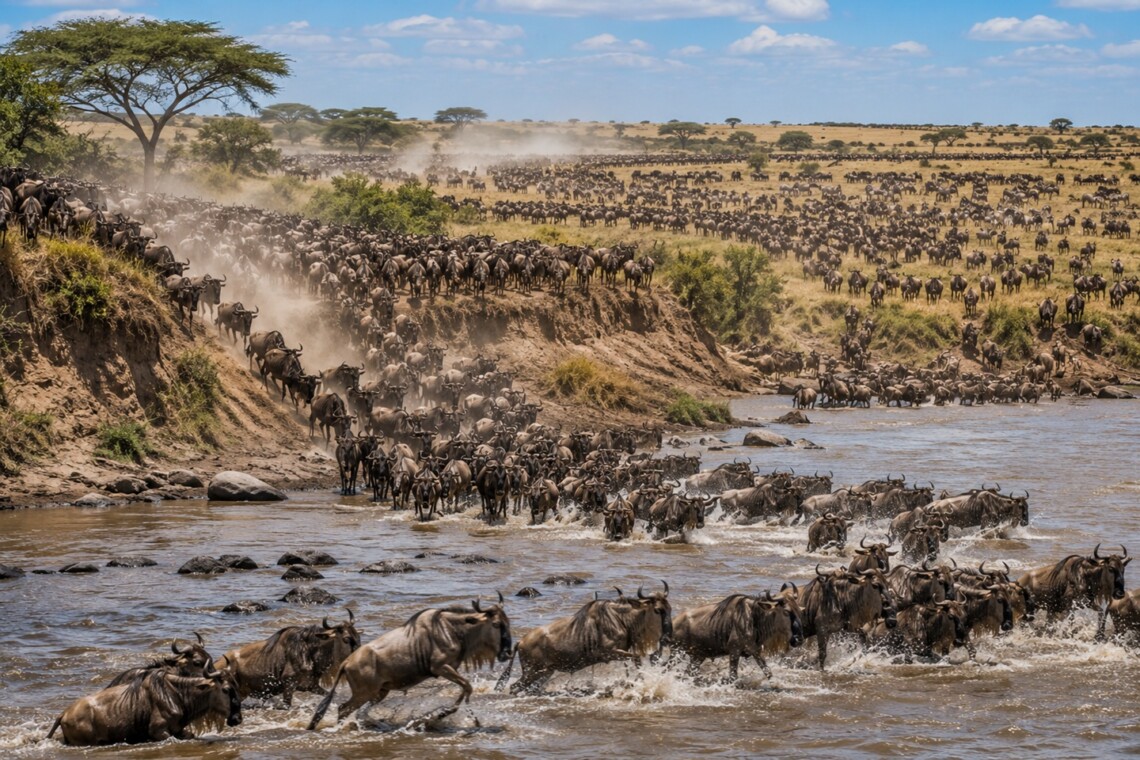




Join The Discussion